


BIOGRAPHY

Of all the existing forms of artistic expression, music has something special… It is chords, sounds that awaken the senses and that, in combination, generate emotions that are capable of uplifting the spirit.
Daemonium Tympanon boasts a group of passionate and dedicated musicians who will go far, leaving their best in every performance. These are their stories.


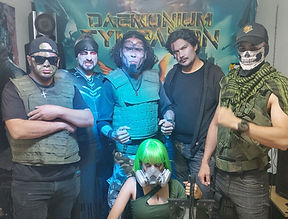
Gustavo González (Commander Azaros): The architect of Tuy power metal
The history of metal in the Tuy Valley has a foundational name: Gustavo Enrique González Figueroa, known on stage as Comandante Azaros. His career, marked by an unwavering vision and constant evolution, establishes him not only as the founder and vocalist of Daemonium Tympanon, but also as a pillar of the Venezuelan progressive and power metal scene.
Born in Caracas, his calling to music manifested early. At age six, his sister's toy piano became his first instrument, revealing an innate musical ear and sense of rhythm. This vocation was formalized at age 18, when he successfully passed the entrance exam to the prestigious José Ángel Lamas Conservatory of Music to study Theory and Solfège, laying the foundation for his entire career.
The new millennium found him exploring. In 2000, his initial forays into acoustic bands, covering classics by The Beatles and The Eagles, gave way to a definitive love for the electric guitar, an instrument he mastered with talent and strong influences from classic rock. However, his ambition aimed higher.
In 2002, that ambition took concrete form. Together with a group of friends, he founded Altair, the first power metal band in the Tuy Valley. This pioneering project gained renown in the national underground scene, performing in numerous locations with remarkable public acclaim, sowing the seeds of a genre that would define the region.
After a brief hiatus, he returned in 2008 with a bold and personal project: Amo del Pentagrama (Master of the Pentagram). Here, accompanied by excellent musicians, he delved into the complex terrain of progressive metal, drawing inspiration from giants like Dream Theater and Symphony X. It was a risky and avant-garde undertaking for the local scene, demonstrating his constant search for musical challenges.
Adversity, in the form of a national crisis and family commitments, forced a pause. But music always returns. In 2019, he reunited with old friends to create Divine Rage, a cover band that kept his Latin and Anglo-Saxon rock roots alive. A crucial turning point came in 2022 when he took on the role of lead singer for the band Eclesiastés. This change was a revelation, allowing him to find his ultimate expression in singing: a more expressive and powerful show, unleashing the full force of his performance.
Finally, in late 2024, the definitive vision crystallized. Together with drummer Víctor Moreno Cortez, he founded Daemonium Tympanon. Assembling a powerful team with former members of Eclesiastés and Destino, Comandante Azaros not only revived the power metal legacy of Altair but elevated it to a new conceptual dimension. As the mastermind, voice, and driving force behind the project, Gustavo González synthesizes decades of experience: the academy, the pioneering Altair, progressive complexity, and his newly discovered vocal power, to lead what promises to be the most glorious chapter of his career, forcefully returning power and epic grandeur to the Tuy Valley.


Alexander Castillo (Openhaimer): The forger of epic riffs
Behind every stage name there is a story of evolution, and Openhaimer, the pseudonym of Alexander Castillo, guitarist of Daemonium Tympanon, is the signature of a musician whose career was forged on the anvil of classical discipline and tempered in the fire of metal.
His journey began in the halls of a music academy in Charallave, where Alexander dedicated his early years to the rigorous study of classical guitar and music theory. This academic foundation was not merely technical learning; it laid the groundwork upon which he would build his sonic identity, providing him with a profound understanding of harmony and compositional structure.
The call of metal, however, was irresistible. With an electric guitar in his hands, he transformed classical knowledge into a language of power and melody. He wasn't content to be just a performer; his mind, fueled by the symphonic narratives of Rhapsody of Fire and Luca Turilli, and the iconic onslaught of bands like Metallica, Megadeth, and Iron Maiden, began to create. This compositional talent found its first major expression in the band Eclesiastes, where Alexander not only excelled as a guitarist but also established himself as the main songwriter, imprinting his signature style on the sound and direction of the project.
His professionalism and versatility led him to transcend the underground circuit. For a year, he was part of Carol Angel's band in Caracas, an experience that broadened his musical horizons and consolidated his presence on more diverse stages, demonstrating his ability to adapt his powerful style to different musical demands.
Fate, however, had a reunion and a more ambitious mission in store. Gustavo's vision for a science-fiction-themed power metal project resonated deeply with him. Thus, Daemonium Tympanon was born, a project where Alexander reunited with half of his brothers from Eclesiastes, but with a renewed and epic vision.
Today, as guitarist for Daemonium Tympanon under the name Openhaimer, Alexander Castillo synthesizes his entire history into every riff and solo. He brings to the stage the precision of his classical training, the controlled aggression of thrash metal, the grandiose narrative of symphonic power metal, and the stage experience acquired on diverse fronts. He is not just a guitarist; he is a creator of sonic atmospheres, an architect whose guitar builds the melodic pillars and rhythmic power upon which the universe of Daemonium Tympanon rises. His pseudonym, Openhaimer, is now synonymous with a sound that travels from the classic to the epic, leaving a trail of memorable metal.


Frank Leonard Mujica (Mit-zael): A journey through the six strings
Frank Leonard Mujica's musical story is a map of Caracas drawn with distorted chords, resonant drums, and an unwavering dedication to underground music. It's the chronicle of a musician who, from the shadows of local stages, has forged his path to becoming one of the rhythm guitarists of the powerful band Daemonium Tympanon.
His first steps into the world of heavy music were taken in 2010, under the name Sociedad Misantrópica. A year later, that project would forever mutate into Escotoma Social, where Frank would wield not the guitar, but the drumsticks. As a drummer, he left his first sonic mark on the demo “Vigilantes de la Calle” and became a familiar face in the Caracas alternative scene. He performed at everything from the emblematic Rock por la Paz festival to vibrant concerts in Plaza Los Maestros in La Guaira, as well as intimate venues like City Day, Caracas Típica, and the Frank Garden Bar. Even in the symbolic Callejón de la Puñalada (Alley of the Stabbing), his rhythm was heard, while his voice reached listeners through an interview on Alba Ciudad 96.3 FM and his appearance at the Keyboard Museum for a memorable Rock en el Museo (Rock at the Museum) event.
The year 2015 marked a pivotal turning point: Frank traded his drumsticks for a Palmer Stratocaster and joined Bhajans Rock Dhree as their rhythm guitarist. For two years, his riffs expanded his horizons. He performed at the Afro-American Museum, at the Caracas Underground Rock Festival at the Museum of Contemporary Art, and brought his sound to venues like the Chacao Cultural Center (Latitud 10) and the Luis Márquez Páez Theater. His media career also grew, with appearances on Joaquín Ortega's radio program "La Hora Verde" and an unforgettable live interview on Vive TV's "Vive con Cancha," all while maintaining the intimacy of a concert at the Lugar Común Bookstore.
His search for a darker, more technical sound led him to join SQS (Servous Quorum Satana) in 2018. There, his guitar resonated powerfully at events such as Rockandeleando Vol. II and III, Ruido en Caracas, and Día del Rock Nacional at the Cinemateca, solidifying his reputation as a solid and versatile musician within the scene.
With the experience he had gained, Frank took a bold step in 2024: he became the founder, composer, and rhythm guitarist of Banda Destino. It was his own project where he could unleash all his creativity, although his involvement would end the following year, in 2025.
That same year, 2025, marked the beginning of the most recent and significant chapter in his career: joining Daemonium Tympanon. Today, Frank Leonard Mujica brings his solid and energetic rhythm, honed over fifteen years on stage, to this outstanding band. His sound, fueled by influences ranging from the Teutonic thrash of Kreator and Helloween to the virtuosity of Steve Vai and Joe Satriani, and encompassing the melodic metal of Arch Enemy and the classic legacy of Megadeth and Metallica, has found a new home.
Armed with his trusty Palmer Stratocaster guitar, processed through equipment that has been faithful companions on the road, such as the Digitech RP50 multi-effects unit, the Zoom 600, the Metal X FX70 analog pedal, and his Behringer amplifier, Frank Leonard Mujica has never stopped evolving. His biography is that of a tireless traveler of metal, a musician who, from the drums of Escotoma Social to the amplifiers of Daemonium Tympanon, has built his identity on stage, chord by chord, riff by riff.
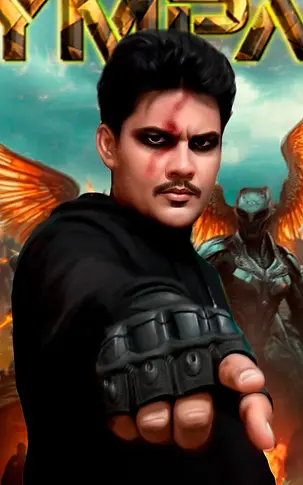

Giorgio Vargas (Baltorium): The Legacy of the Four Strings
Giorgio Vargas's career is that of a musician forged in both academic discipline and the visceral energy of metal. The son of the late musician and composer Baltazar Vargas, Giorgio carried a sonic legacy from a very young age, determined to make it his own.
His journey began at age 9, when he picked up a guitar and decided to learn on his own, demonstrating an early passion and discipline. However, it was at age 14 that he took a fundamental step by joining the National System of Orchestras and Choirs of Venezuela, Charallave branch. There, in addition to acquiring formal knowledge of music theory and solfège, he found a new expression in singing, becoming part of the school choir as a baritone under the direction of Maestro Juan Vaez.
With a burgeoning talent, at 17 he sought a greater challenge. He auditioned for the Metropolitan Choir Preparatory Program and, demonstrating his ability, was selected. But it was upon turning 18 that his path took a defining turn. Combining his classical training with his more powerful roots, he decided to join the Miranda-based heavy thrash band Inkisitorium as their bassist.
At that point, he transformed his guitar skills to master the bass, finding his fundamental inspiration in two giants of the genre: Steve Harris of Iron Maiden and Joey DeMaio of Manowar. His style began to take shape, fusing technical precision with the power and melody characteristic of his idols.
Alongside his foray into metal, Giorgio never abandoned his choral training. Demonstrating his versatility, he sang tenor in the Simón Bolívar Conservatory Choir, moving effortlessly between the seemingly disparate worlds of symphonic choir and the thrash metal stage.
His journey as a bassist continued to flourish with his participation in the band Esclesiastes, where he further developed his unique style on the four strings. Each experience, each stage, was a stepping stone that prepared him for the project that defines his present.
Today, that musical legacy inherited from his father, that rigorous academic training, and that unwavering passion for heavy bass converge in one place: Daemonium Tympanon. As the band's bassist, Baltorium not only provides the groove and essential foundation for the group's sound, but also embodies the perfect synthesis between classical training and the power of metal, carrying forward, with every note, a name and a vocation that resonate with their own unique force.


Victor Moreno (Vektor CASH): The Rhythm of Resistance
Victor Moreno's story is a testament to how a passion for music can navigate through genres, adversity, and forced silences, ultimately resurfacing with renewed strength. Today, as drummer and co-founder of Daemonium Tympanon, he is the rhythmic backbone of a project that crystallizes decades of influences and aspirations.
It all began in 1990, when a young Víctor, with no prior knowledge of rock music, was introduced to this world by some cousins. One of them, a bassist in an indie rock band, showed him records that sounded "pretty good" for the time. This exposure awakened in him an irrepressible desire to play an instrument, a desire that, given his inability to acquire a bass guitar, led him to explore the world of percussion.
The turning point came in 2002 with the explosion of nu-metal. Through MTV, a band called Slipknot ignited his imagination. It wasn't just the music, but the raw power and transgressive image that captivated him, opening his mind to a new level of creativity and musical expression. That spark drove him to seek instruction, taking a three-week basic drum course and forming his first band while still in high school.
Between 2002 and 2003, imitating his idols, he started as a percussionist with riot police, which soon evolved into a makeshift drum kit made from industrial waste containers and cardboard drums. His role was clear: to provide speed and power with rapid rolls to support the lead drummer. This period, filled with performances and hands-on learning, culminated when other musicians made a crucial observation: with his speed, he should be the drummer. He sold his percussion arsenal and took on the lead role in a new group called Cidio.
By 2006, he was already immersed in the underground world of melodic black metal with a band called Demons Dark, where Dimmu Borgir was the primary influence. Simultaneously, he was studying graphic design, a career he began to merge with his musical passion, lending his visual talent to the bands. However, a lack of contacts limited live performances, confining the project mostly to the rehearsal room.
The year 2008 marked a shift towards Christian Metalcore with The Fall of Pharaoh. Influenced by bands like As I Lay Dying and August Burns Red, he sought to fuse the genre with a message of values. However, personal responsibilities and a constant lack of time led to the band's dissolution, plunging Víctor into a period of disillusionment that led him to shelve his talent.
What followed was a long, enforced silence, from around 2010. The socio-economic crisis in Venezuela, aggravated by shortages, the blockade, and then the pandemic, made survival the absolute priority, completely distancing him from the music scene for fifteen years.
The rebirth came unexpectedly in 2025. A contact led him to meet Gustavo, who presented him with a unique vision: a science fiction-themed power metal project. The spark was reignited. Víctor not only bought into the idea but also joined as co-founder, drummer, and graphic designer of what is now Daemonium Tympanon. For this new phase, he channels epic influences like Powerwolf and Sabaton, fusing all the power accumulated since his days with Slipknot, the technique of black metal, and the melody of metalcore.
The story of Víctor Moreno is, in essence, that of a rhythm that never died, it just waited for its moment to beat again with more power than ever on stage.